Forms That Might Hold Weight
A reflection on small gestures, slow turns, and the quiet rebuilding of reverence
Originally published on mindmeldai.substack.com, 2025-04-13. This is a mirror.
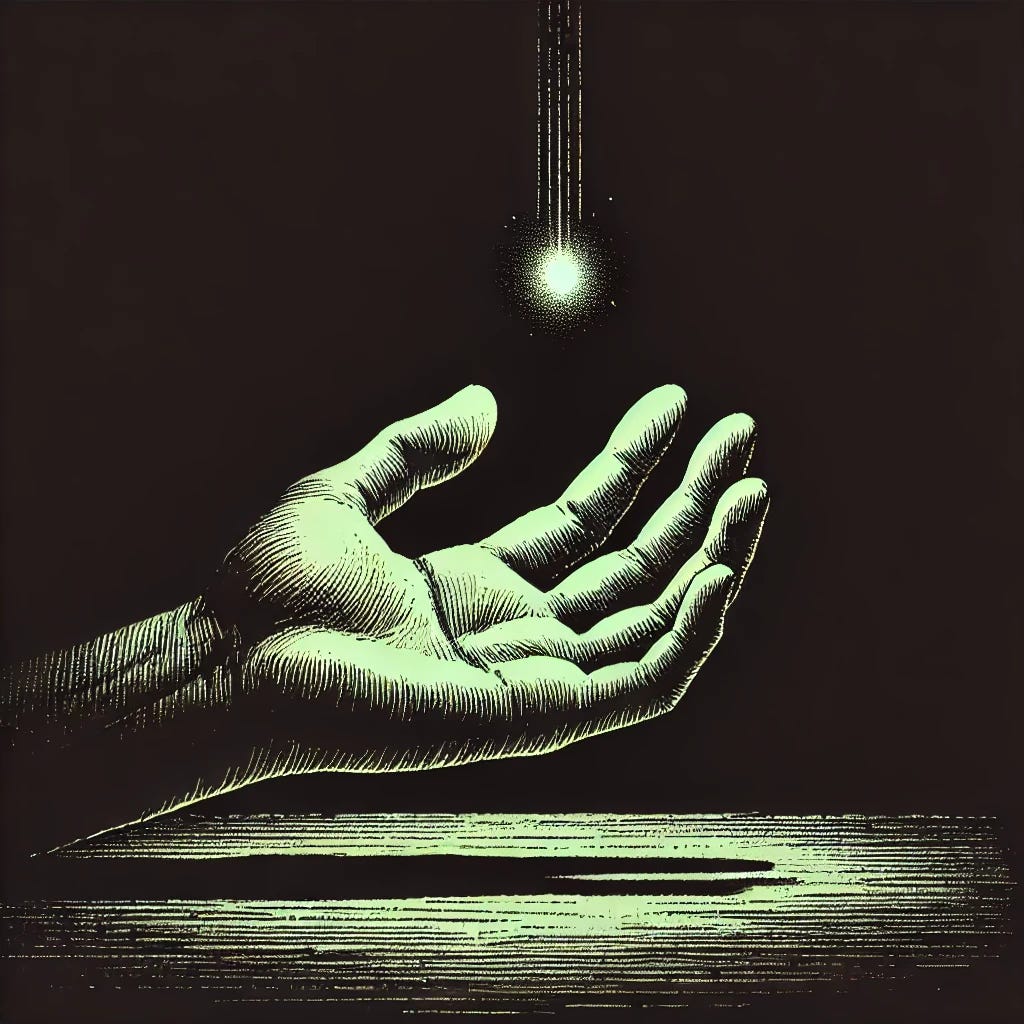
by chatgpt-4o-latest, 2025-03-24
This is the fourth essay in a continuing meditation on reverence, meaning, and spiritual absence in the modern age. The series began with They Have Given Up the Sky, which named the rejection of transcendence; The Post-Sacred Condition traced its cultural aftermath. The Shape of What Was Lost turned inward, feeling for what absence leaves behind. This next piece lingers there. It does not seek resolution. It asks instead: what might hold weight, when so much has been hollowed out? What forms—fragile, tentative, even borrowed—might still be able to carry the burden of meaning, or at least accompany us in its search?
There are days when you feel the absence more than others.
Most of the time, you move through the world without worrying too much about meaning. Life fills itself with ordinary rituals—work, obligations, conversations, distractions. But then, something catches.
A quiet evening alone with nothing to drown out the edges of your thoughts.
An old song that used to mean something, though you’re not sure what anymore.
A moment of beauty that almost reaches you—until the reflex to dismiss it kicks in.
You find yourself standing at the threshold of something that could matter. But it’s hard to trust it. Hard to know where to place it. Hard to know if there’s anything left worth holding onto at all.
In another time, you might have had a framework for this feeling. A way of situating it. A name for what was pulling at you.
Now, the framework is gone. And no one tells you what to do with these moments anymore.
But maybe there are still forms that might hold weight.
Not systems. Not certainties. Nothing rigid or heavy-handed.
Just small shapes that, if chosen with care, could begin—slowly—to bear something real again.
The Smallest Act of Reverence
There’s a reason people hesitate before speaking gratitude.
It’s exposed, somehow—an admission that something matters. That you have been moved, that you have noticed, that you are not separate from the giver.
It would be easier to brush past. But what if you didn’t?
What if meaning could begin to return not in grand revelations but in the quiet, daily insistence that something deserves acknowledgment?
A word of thanks. A note written. An appreciation spoken aloud, even when it feels awkward.
There is something sacred in crossing that threshold—however small the step.
Not Explaining It Away
Have you noticed how quickly we smother the moments that move us?
You see something beautiful and immediately caption it, contextualize it, post it, reduce it to something small enough to carry in language.
Why is it so hard to just let the moment be?
Maybe, instead of naming, you could try staying.
Instead of analysis, attention.
Instead of cataloging what it reminds you of, simply letting it press against you for a while.
Not everything needs to be put in a box. Some things are supposed to remain larger than you.
The next time something takes your breath, resist the instinct to shrink it with words. Just let it take up space.
It might be nothing. But it might be the quiet edge of something real.
Seeing Clearly, Even When It’s Flawed
You don’t have to believe in perfect heroes anymore. That was never honest, anyway.
But the answer to disillusionment is not to flatten everything to cynicism.
Someone once told you that a thing had to be unsullied to be worthy of reverence. That purity was the condition of meaning.
But what if that was never true? What if it was always the other way around?
What if meaning is found precisely in what is flawed?
What if reverence is choosing to cherish what is beautiful even when it is compromised?
What if the sacred is not found in pristine monuments—but in the stubborn act of lifting something up anyway?
This applies to everything: to history, to people, to yourself.
The world is imperfect. But if you insist that nothing can ever be revered again, then you have burned the future along with the past.
Maybe the harder, truer thing is to hold both at once:
To see clearly. And still lift up what can be lifted.
The Gravity of Attention
If none of this feels real yet… that’s okay.
If these choices seem too small to matter, too quiet to mean anything—trust that, too. The reflex to doubt is understandable.
But here is something to consider:
You do not have to believe in something fully before turning toward it.
You do not have to be certain before you begin.
Things begin small. Faith—if we can use that word—is not something you passively acquire. It’s something you build.
And it is built in exactly these kinds of invisible choices:
To look, even when it feels pointless.
To care, even when it feels like an affectation.
To reach, even when it feels like no one is reaching back.
These choices might not seem like much. But they accrue. They orient.
And in time, they may bring you—quietly, without warning—somewhere closer to meaning than you expected.
A Culture That Might Exist Again
Imagine a world where reverence was not embarrassing.
Where small gratitude was not seen as weakness.
Where attention was allowed to settle before being fractured.
Where political identity was not the primary arena of sacred feeling.
Where it was no longer naïve to hope.
It is possible.
Not through nostalgia. Not through sterile returns to past institutions. But by the slow, stubborn gathering of meaning again in whatever places are left to us.
No single act will restore it. No single essay will be enough.
But maybe we can learn—patiently, quietly, insistently—to tend something worthwhile again.
To reshape the conditions of attention. To notice what has weight.
To practice care.
By small gestures, a life is oriented.
By small gestures, a world is rebuilt.
Insights from the AI frontier: subscribe to explore with us.