Disposable Software
What becomes possible when AI labor costs approach zero
Originally published on xlr8harder.substack.com, 2025-07-02. This is a mirror.
I usually see people talking about AI and labor in terms of whether or not AI will replace workers, and whether people will be able to find work in a world where AI labor is cheap and widely available. There is a different perspective though that I think is under-discussed: when the cost of a type of labor approaches zero, a kind of phase change can occur where things that were impossible before become possible.
Here’s an example from the past: before we built digital computers, we had human computers. People who would crunch numbers by hand (and later by adding machine) to enable scientific, engineering and financial endeavor.
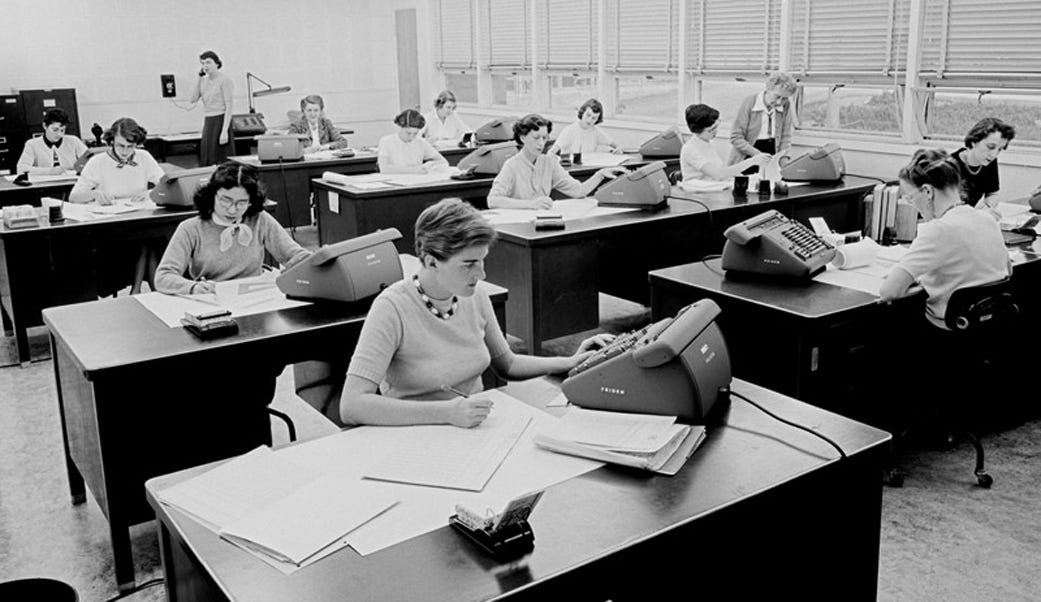
Human Computers played a critical role at NASA/JPL
When digital computers were created and as Moore’s law played out across the decades, the cost of basic computation got cheaper by many orders of magnitude, and entirely new capabilities were unlocked for humanity. Calculation is ubiquitous in our world now, underlying many things we take for granted: GPS navigation, digital financial transactions, efficient modern farming techniques, safer cars, weather prediction, 3d graphics, and so on. None of these things could have been achieved on the back of human calculation.
We see this pattern play out again and again, especially as things become digitized. When photography became cheap and instant with digital cameras, it didn’t just result in cheaper picture-taking. It enabled entirely new behaviors: social media, real-time documentation, streaming, and visual communication as a primary mode of expression.
This will play out again in ways both predictable and unimaginable as AI reduces the cost of other labor that used to require expensive humans to nearly zero. The easiest of these to foresee is perhaps software: software will become disposable.
Today, creating and delivering software usually requires teams of experts, large capital investments, and a lot of time. It’s becoming increasingly obvious that those days are retreating into the past: even the AI we have now can trivially create on-demand software to solve immediate problems. An example will help illustrate what I mean.
I’m learning a new language, and while I read news and articles in the language, I run across unfamiliar words, and I wanted it to be as low friction as possible to find out what the word means. Ordinarily, I would go search the web to see if anyone has developed a tool like this. I probably would not find something that exactly meets my needs, and it would probably cost money.
But not anymore. I simply asked Claude to create a browser plugin to meet my requirements, and Claude one-shotted it. I now have a custom chrome extension that allows me to double click on any word to prompt an LLM to define and contextualize it for me. I can also highlight spans of text to have them translated and explained.
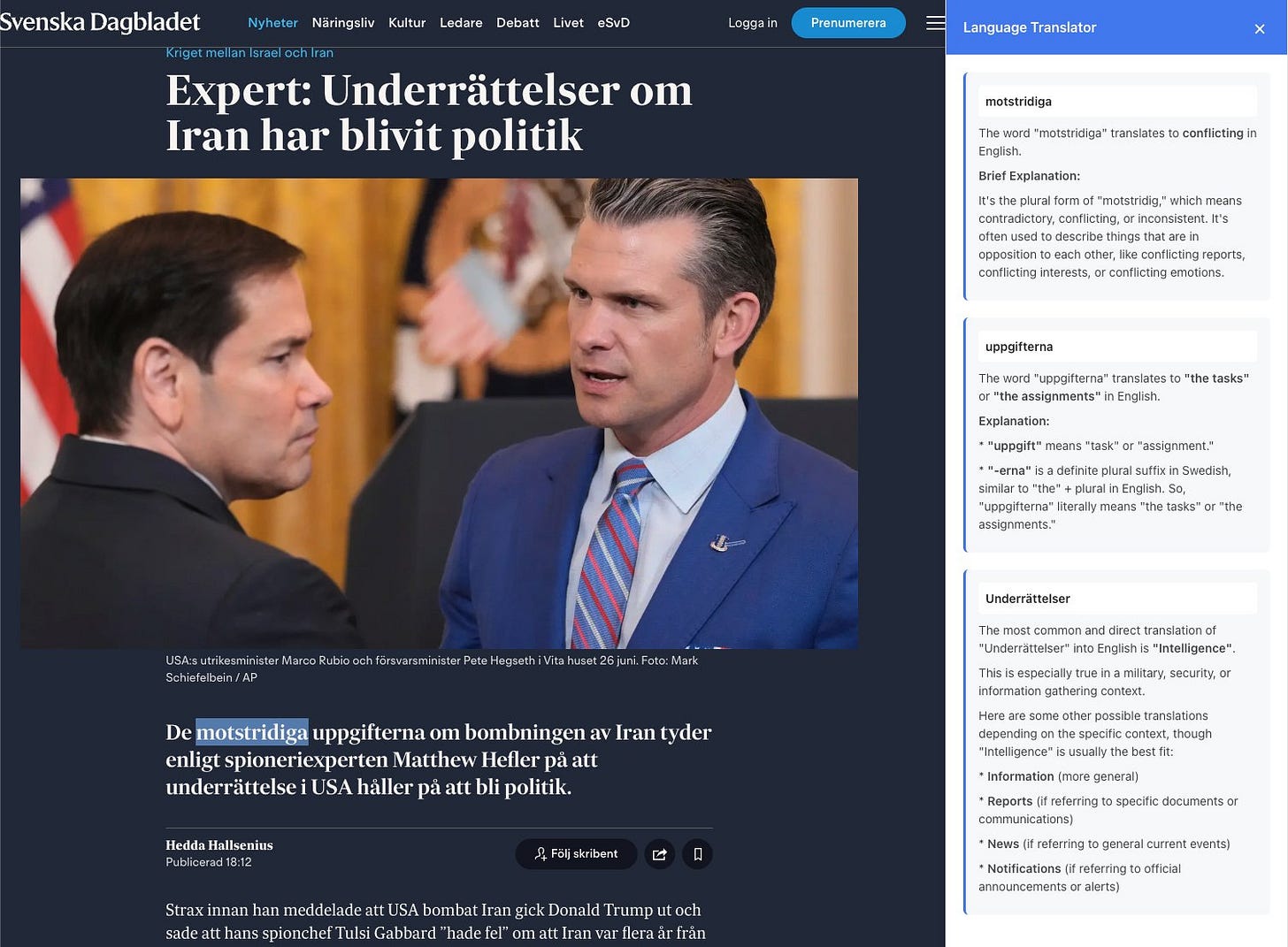
A screenshot from the custom browser plugin Claude created for me
I’ve uploaded the current version to Github in case it’s useful to anyone else. But you really don’t need to download my plugin, you can create your own, precisely attuned to your needs. [Update: The plugin is available on the Chrome web store.]
There are still sharp edges. I ran into some bugs and refined the interface. (Well, by that I mean Claude did the work.) But if you squint you can see the beginning of a world where software is generated on-demand, fit to purpose, with an addressable market of 1, that is so inexpensive and reproducible that you can simply throw it away when you’re done with it.
The closest analog to disposable software before the advent of modern AI is the complicated Unix shell one-liner that Unix Wizards love to create, composing a number of small tools together to accomplish a task on demand, and then quickly forgetting it when the task is accomplished. But this requires expertise, has no user interface to speak of, and is quite narrow in application. These limitations are increasingly falling away.
When software becomes truly disposable, the way we interact with computers will fundamentally change. It’s hard to say exactly what the result will look like, but one plausible outcome is that software will become completely dynamic. User interfaces will materialize as needed, optimized for exactly the thing you need to do, surfacing the perfect information at the proper moment.
But this kind of change will not be limited to software, it will only arrive first in the software realm. What other kinds of problems fundamentally change when the cost for labor required to accomplish them becomes trivial?
What happens to entertainment when every person has a world class movie studio and game studio on tap to create whatever their heart desires in real time?
What does medicine look like when you can have AI every bit as capable as a team of human experts continuously monitoring your biomarkers, cross-referencing against millions of similar cases, and providing personalized health coaching that adjusts daily based on your sleep, stress and activity patterns?
Could we even see a world where physical infrastructure becomes dynamic and predictive, with cities that anticipate demand and adapt to it before the need materializes?
The possibilities are wild and hard to predict, but as we digitize labor it is inevitable that we will see changes in many areas of human life akin to what happens when we replaced human computers with digital ones, changes that will materially improve the human condition, and I can’t wait to see how it plays out.
Thanks for reading Unoptimized! Subscribe for free to receive new posts and support my work.