The Feeling of Productivity
Originally published on xlr8harder.substack.com, 2026-07-21. This is a mirror.

Depression isn’t sadness. I’ve lived with it my whole life, and sadness is the consequence; depression is how you get there.
I think of depression as an information problem. As you decide how to spend your time, your sense of which things matter—your ability to anticipate reward—is compromised. The feedback loop is broken. The world is drained of contrast.
Your inputs are bad, and so your decisions are bad, and you gradually end up feeling worse and worse while the very tool you are relying on to find your way out is actively misleading you.
Addicts can follow a similar trajectory. Addicts’ ability to match their decisions with reality and consequence becomes compromised. In recovery circles, they call the place you end up, when reality reasserts itself and presents the bill that is due, rock bottom. Arriving there is one of the few reliable openings for the severely addicted to make changes to their life, because it is a place where the view of reality is unusually, painfully clear.
The structure of a 12 step program, viewed as an adaptation to an epistemological problem, makes a lot of sense. You admit you can’t navigate on your own. You repay moral and other kinds of debts, making the costs you have accrued clear. You place yourself in a structure of accountability, because you accept that your judgment is compromised, and compromised in a way that you can’t reliably reason your way past.
In both depression and addiction, the instrument you use to evaluate your choices is the thing that’s broken. That kind of challenge is about to get much more familiar: AI is changing the world faster than our internal instruments can recalibrate. Faster than we can notice, even.
Being productive feels good, and we often rely on our sense of accomplishment to help orient us toward what we should be working on. But that sense of accomplishment and the creation of real value are becoming increasingly disconnected.
The people who first started writing software with agents immediately noticed a tension: they could do the work today, or they could do it with less effort in three months, or less effort still in six. What exactly is accomplished when you burn your evenings and weekends to build something that someone else can just one-shot in a few months?
People are sacrificing the most important moments of their lives—relationships with partners, time with a young child—to an AI quota reset schedule, rushing to build something that can be trivially reproduced in a few months. And that feels like a small tragedy.
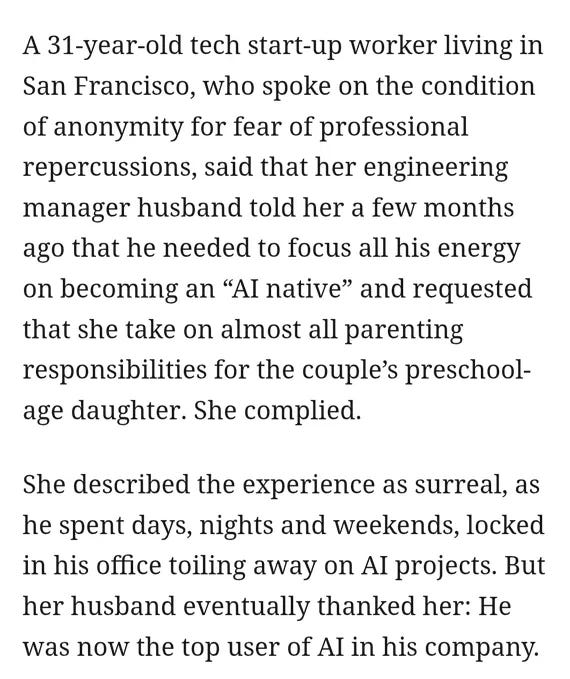
The biggest winners of the American economy fear they’re sinking fast, Washington Post, July 2026
The kind of work that is worthy of sacrifice has changed, but we continue to measure by an old standard that no longer fits. As building gets radically cheaper, everyone’s best app is the one built exactly to their needs. So the value in building a thing reduces toward the question of whether it scratches a personal itch that is worth to you what it costs to scratch.
Some value survives this. Being early can still matter—for position, reputation, relationships, or windows that really close. Learning still matters, though it decays faster than ever and can become its own treadmill. Notice what all of it has in common: none of it is about the thing being made. And an unanswered question lingers: you gain reputation or position–in order to do what? Economic value was a reasonable proxy for doing something that mattered, and while that proxy is failing, mattering itself is still here. Perhaps in reorienting we can begin to see it more clearly than before.
Think back to that small tragedy of irreplaceable moments: this is the time to figure out what actually matters to you.
In living with depression, I learned one thing above all: things matter even when you cannot feel them mattering. The feeling can mislead, and when it does, you have to act on what you know instead of what you feel, and trust that the mattering is still there. The feeling of productivity is coming loose from the fact of it, and it may be that no rock bottom is scheduled to tell you so. You’ll have to look on your own initiative. What you already know to matter is waiting for you when you do.
Thanks for reading Unoptimized! Subscribe for free to receive new posts and support my work.